How to Structure Ad Copy for Local Service Businesses on Google PPC
Learn how to write high-converting Google PPC ad copy for local service businesses. Discover headline formulas, geo-targeting syntax, and trust triggers.

Key takeaways
Executive Summary- Local searchers operate under acute urgency; Headline 1 must immediately match their specific trade service and target city.
- Structuring Responsive Search Ads into functional categories (Geo, Speed, Trust, Offer, CTA) prevents repetitive, awkward ad copy.
- Prominent trust markers—including state licensing, insurance, background checks, and flat-rate pricing—dismantle consumer skepticism.
- Click-to-call mobile assets and call extensions routinely outperform web forms for high-urgency home service repairs.
Table of Contents
- Executive Summary: Core Pillars of High-Converting Local Ad Copy
- The Anatomy of a High-Converting Local Responsive Search Ad
- Strategic Description Writing: Solving the Full Customer Problem
- Step-by-Step Implementation: Building a Local Service PPC Campaign
- Emergency Bidding Strategies and Dayparting Dynamics
- Practical Scenarios: Trade Case Studies (HVAC, Plumbing, Legal)
- Local Service Landing Page Optimization and Message Matching
- Common Local Service Ad Copy Mistakes and How to Avoid Them
- Strategic Summary and Local Dominance
Crafting high-converting ad copy for local service businesses on Google PPC requires an entirely different psychological playbook than national e-commerce or B2B software advertising. When a local homeowner searches for an emergency plumber, an electrician, a commercial roofer, or an HVAC repair technician, they are almost never engaged in leisurely product research. They are experiencing an immediate physical problem, often under acute stress, and need a trustworthy, licensed professional who can arrive at their doorstep today. In this tactical copy blueprint, you will master the proven headlines, geographic pinpoints, trust badges, and urgency triggers needed to capture qualified local service calls while filtering out time-wasting price shoppers.
Local PPC advertising is won in the first microsecond of visual scanning. With modern Responsive Search Ads (RSAs) serving up to three headlines and two descriptions simultaneously alongside local call extensions and location pins, your ad copy must deliver instant relevance. If your headlines fail to reflect the searcher's specific municipal area, state your licensing credentials, and promise rapid dispatch, prospects will simply click the competitor listing immediately below you. By systematically structuring your ad copy assets, you turn clicks into booked service dispatch appointments.
Executive Summary: Core Pillars of High-Converting Local Ad Copy
Before reviewing headline formulas and ad construction frameworks, internalize the four operational cornerstones that dictate local PPC advertising success:
- Hyper-local geographic pinpointing: Including specific city, neighborhood, or borough names in Headline 1 establishes immediate physical proximity.
- Urgency and response time clarity: Explicit promises such as 'On-Site in 60 Mins' or 'Same-Day Service Guaranteed' alleviate customer panic.
- Institutional trust and risk reversal: Highlighting state licensing, insurance coverage, background-checked staff, and upfront pricing eliminates consumer fear.
- Direct, friction-free calls to action: Prioritizing click-to-call assets and emergency booking links over lengthy multi-page quote forms.
The Anatomy of a High-Converting Local Responsive Search Ad
Google Responsive Search Ads allow advertisers to provide up to fifteen headlines and four descriptions. The machine learning algorithm tests combinations to determine which pairings yield optimal click-through and conversion rates. However, relying on Google to combine assets without human guidance frequently results in awkward, repetitive ad copy. Successful local service businesses structure their fifteen headlines into functional, complementary categories:
| Asset Category | Number of Headlines | Strategic Function | Battle-Tested Headline Examples | Pinning Recommendation |
|---|---|---|---|---|
| Keyword & Geo Matching | Headlines 1 to 3 | Echo exact search query and target municipality | 'Emergency Plumber Austin TX', 'Local Austin HVAC Repair', '#1 Plumber Near You' | Pin to Headline Position 1 |
| Speed & Availability | Headlines 4 to 6 | Communicate immediate dispatch and emergency coverage | '24/7 Rapid Emergency Dispatch', 'Same-Day Service Available', 'At Your Door in 60 Minutes' | Pin to Headline Position 2 |
| Trust & Accreditation | Headlines 7 to 9 | Dismantle skepticism regarding safety and pricing | 'Licensed, Bonded & Insured', 'Upfront Pricing — No Surprises', 'Over 500 5-Star Local Reviews' | Pin to Headline Position 3 |
| Offer & Value Incentive | Headlines 10 to 12 | Provide financial incentive to call immediately | '$50 Off First Service Call', 'Free Estimate With Repair', '100% Satisfaction Guarantee' | Allow algorithmic rotation |
| Direct Call to Action | Headlines 13 to 15 | Instruct the user on immediate action | 'Call Now for Fast Dispatch', 'Book Online & Save 10%', 'Speak to a Master Tech Today' | Allow algorithmic rotation |
Adhering to the character limits and editorial standards published in the Google Ads editorial policies ensures that your local ad copy passes automated policy checks instantly without triggering disapproval flags.
Strategic Description Writing: Solving the Full Customer Problem
While headlines win the initial click, descriptions provide the room to thoroughly resolve buyer hesitation. With ninety characters available per description line, local service advertisers must avoid filler copy like 'We are the best company in town since 1998'. Every word must advance a compelling reason to hire your business right now.
High-converting local descriptions follow a proven three-part formula: Problem Agitation + Operational Solution + Clear Action. For example: 'Burst pipe or backed-up drain? Our licensed Austin master plumbers provide 24/7 emergency dispatch. Upfront pricing, zero hidden fees, and 100% satisfaction guaranteed. Call now for same-day repair!' This concise paragraph directly acknowledges the customer's distress, demonstrates credibility, and directs the next step.
To draft, count characters, and preview your ninety-character descriptions seamlessly, use our free online text editor and word counter to ensure your ad copy fits Google's technical constraints perfectly.
Step-by-Step Implementation: Building a Local Service PPC Campaign
Executing a high-performing local search ad campaign requires tight coordination between ad copy, geographic targeting, and mobile ad assets. Follow this sequential operational roadmap:
- Step 1: Segment Campaigns by Specific Service and Municipality. Never create a single generic campaign targeting an entire metropolitan area with all services mixed together. Split campaigns by core trade line (e.g., 'Emergency Drain Cleaning', 'Water Heater Replacement', 'Sewer Line Repair') and by geographical territory. This ensures Headline 1 matches the exact service and city query searched.
- Step 2: Deploy Location Insertion Syntax Dynamically. Leverage Google Ads dynamic location insertion tags in your headlines, such as {LOCATION(City):Local} Service Experts. When a user searches from Scottsdale, the ad automatically displays 'Scottsdale Service Experts'. This delivers immediate geographic resonance without requiring separate ad sets for dozens of suburban zip codes.
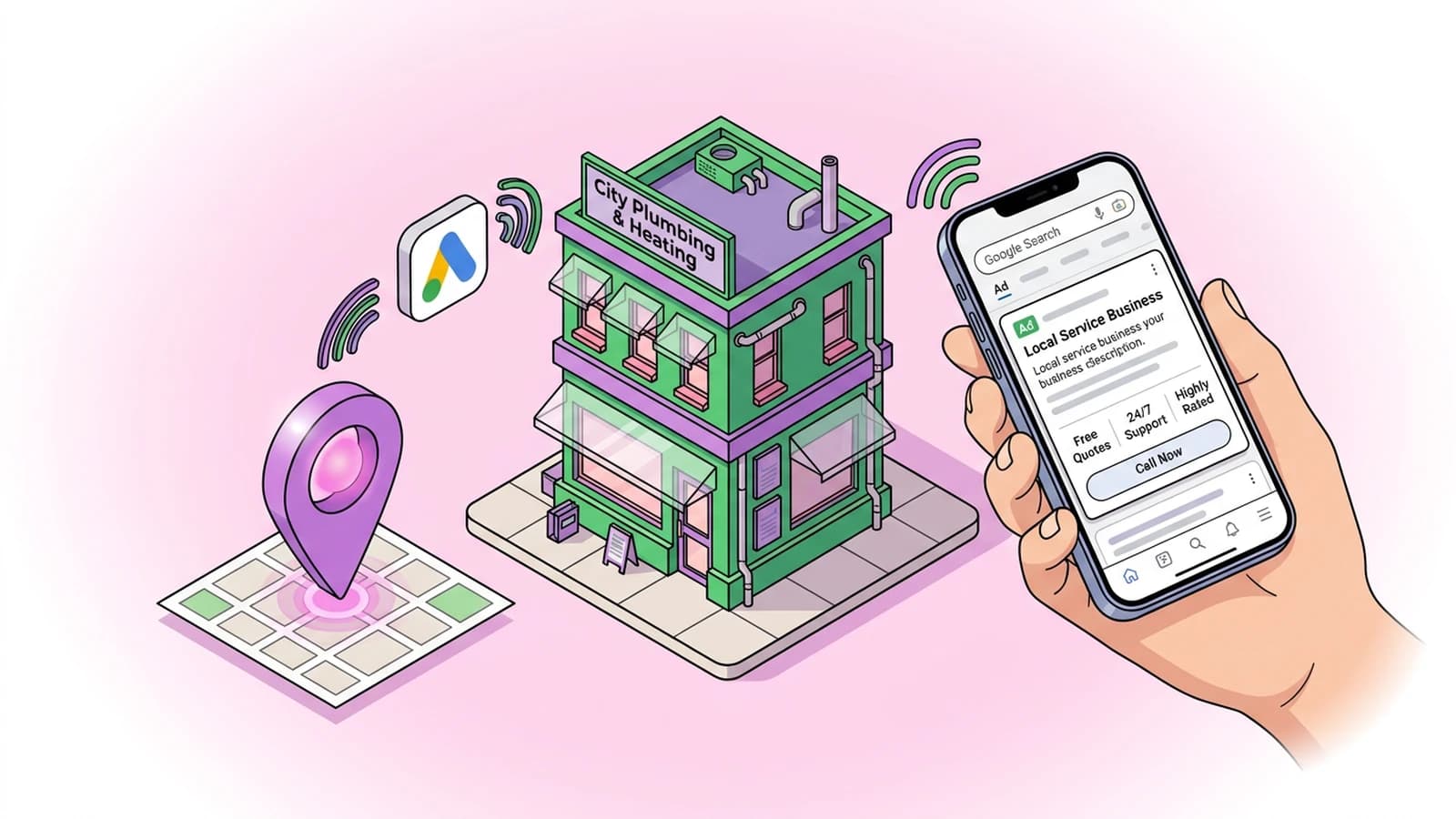
- Step 3: Mandate Call Assets and Local Business Profile Links. Local service decisions are primarily executed over the phone. Link your Google Business Profile to your Google Ads account to trigger local map pack search ads, and attach a dedicated Call Asset with call reporting enabled. For mobile searchers, configure call ads that prompt an instant phone dial upon clicking.
- Step 4: Protect Budgets with Proactive Negative Keyword Lists. Prevent your budget from draining on DIY tutorials, parts stores, and employment queries by deploying dedicated negative keyword lists containing terms like 'diy', 'how to', 'home depot', 'parts', 'apprentice', and 'salary'.
- Step 5: Reinforce Local Entity Authority with Citation Consistency. Google rewards advertisers whose physical business data is consistent across the web. Reinforce your local search presence and map pack credibility by investing in professional local citation building to ensure your business Name, Address, and Phone number (NAP) align perfectly with your PPC landing pages.
Emergency Bidding Strategies and Dayparting Dynamics
In local home services, conversion probability fluctuates dramatically throughout the day. Searchers facing emergency issues—such as an overflowing toilet at 6:00 AM or a frozen heating unit at 11:00 PM—exhibit near-instant conversion velocity, but only if an immediate dispatch option is visible. Conversely, daytime mid-afternoon searches often reflect casual comparison shopping.
Aligning your automated bid adjustments with historical dispatch availability maximizes capital efficiency. Applying a positive bid adjustment of twenty to thirty percent during peak emergency morning hours (6:00 AM to 9:00 AM) captures high-intent homeowners before competitors begin their workday. Pairing these time-decay bid adjustments with dynamic emergency headline copy guarantees dominant ad positioning when customer urgency is highest.
Practical Scenarios: Trade Case Studies (HVAC, Plumbing, Legal)
Examining real-world local service performance reveals the dramatic impact of copy restructuring. In an emergency plumbing account in Tampa, Florida, the original ad copy featured generic branding: 'Tampa's Trusted Plumbers | Quality Service Since 2005 | Call Today'. This ad generated a 3.8% click-through rate and an eighty-four dollar cost per call.
The ad was restructured around immediate emergency response: 'Emergency Plumber in Tampa | At Your Door in 60 Mins | No Extra Night or Weekend Fees | Licensed Master Plumbers. Call Now for $50 Off!'. Within two weeks of launching the restructured copy, click-through rate jumped to 8.4% and cost per booked phone call plunged to thirty-nine dollars, more than doubling the client's monthly booked service revenue without increasing their five-thousand-dollar monthly ad budget.
Local Service Landing Page Optimization and Message Matching
Your ad copy is only as effective as the landing page it drives traffic to. A major source of local service bounce rate occurs when an ad promising 'Austin Emergency Plumbing' routes visitors to a generic homepage featuring company history and corporate mission statements. Homeowners under stress will not navigate a multi-level menu to find a phone number.
Ensure that every ad group routes traffic to a dedicated, geolocated landing page that mirrors your ad headlines precisely. Feature a prominent, sticky click-to-call phone number at the top of the mobile viewport, accompanied by an instant dispatch estimate and verified Google review badges. Maintaining seamless visual and verbal continuity between search ad copy and landing page elements dramatically elevates conversion rates while driving cost per booked appointment down.
Common Local Service Ad Copy Mistakes and How to Avoid Them
Local service PPC accounts frequently suffer from simple copywriting mistakes that inflate acquisition costs. Avoid these frequent errors:
- Leading with Corporate Vanity: Wasting Headline 1 on your legal company name (e.g., 'Smith & Sons Enterprises LLC') wastes your most valuable real estate. A customer with a flooded basement does not care what your company is named; they care that you can fix their basement right now. Put your trade and location in Headline 1.
- Hiding Pricing Transparency: Consumers fear predatory local contractor pricing. Ads that say 'Affordable Rates' sound evasive. Ads that say 'Flat-Rate Diagnostic Fee: $49' or 'Free On-Site Quotes' eliminate fear and filter out tire-kickers who expect free labor.
- Sending Mobile Callers to Multi-Step Web Forms: When a local homeowner's furnace dies in winter, they will not fill out a ten-field quote form on a mobile website. Ensure mobile ads feature prominent click-to-call buttons and short, three-field emergency dispatch forms.
- Failing to Align Ad Schedule with Staffing Hours: Advertising '24/7 Emergency Service' when no one answers the company phone after 6:00 PM burns expensive clicks on missed calls. Only advertise emergency availability during hours your dispatch team is physically prepared to answer within three rings.
Strategic Summary and Local Dominance
Local search advertising is fundamentally about empathy, speed, and trust. By recognizing that local searchers are seeking immediate relief from urgent problems, structuring your Responsive Search Ads to answer their core questions in under two seconds, and highlighting verified credentials, you build an unshakeable competitive moat in your service area.
Audit your local search ad copy today. Pin your target city and core trade to Headline 1, state your upfront pricing and licensing in Headline 2, and deploy active Call Assets. Aligning your ad copy with real customer needs will fill your service dispatch schedule with high-margin local jobs week after week.
Frequently asked questions
The most effective structure pairs your core service and target municipality in Headline 1 (e.g., 'Emergency Plumber Dallas TX'), an urgent response time in Headline 2 (e.g., 'At Your Door in 60 Mins'), and an upfront trust marker in Headline 3 (e.g., 'Licensed, Insured & Upfront Rates').
Justin edits and fact-checks articles, keeping every post accurate, readable and consistent with the house style.