How to Convert Audio Recordings to Accurate Text Transcripts for Free
Discover how to convert audio recordings to accurate text transcripts using free AI tools, optimize recording hygiene, and turn spoken dialogue into valuable digital assets.

Key takeaways
Executive Summary- Convert audio recordings to accurate text transcripts to dramatically improve SEO visibility.
- Prioritize clean microphone positioning and acoustic dampening for maximum accuracy.
- Utilize automated speaker diarization to organize multi-party interview conversations.
- Repurpose text transcripts into blogs, summaries, and social media quotes.
Capturing spoken dialogue from interviews, business conferences, and podcasts is vital for modern media teams, and learning how to convert audio recordings to accurate text transcripts without incurring expensive transcription agency fees unlocks massive operational efficiency. Modern automated speech recognition technologies powered by neural acoustic modeling transform raw audio into publication-ready written transcripts in minutes.
Historically, manual audio transcription was a grueling bottleneck, requiring human typists up to five hours of meticulous playback to transcribe a single hour of recorded speech. Today, open-source neural acoustic architectures and cloud speech processing utilities deliver remarkable word accuracy rates exceeding ninety-five percent across diverse recording environments.
Accurate transcripts do not merely provide documentation; they unlock immense search engine discoverability, enable multi-platform content repurposing, and satisfy international web accessibility compliance standards. Mastering the end-to-end automated transcription pipeline empowers creators to maximize the commercial value of their spoken audio assets.
When organizations capture hundreds of hours of executive meetings, customer discovery interviews, and webinar recordings, leaving that information trapped in raw audio files represents massive lost productivity. Transforming spoken dialogue into searchable text makes company knowledge instantly discoverable across digital repositories.
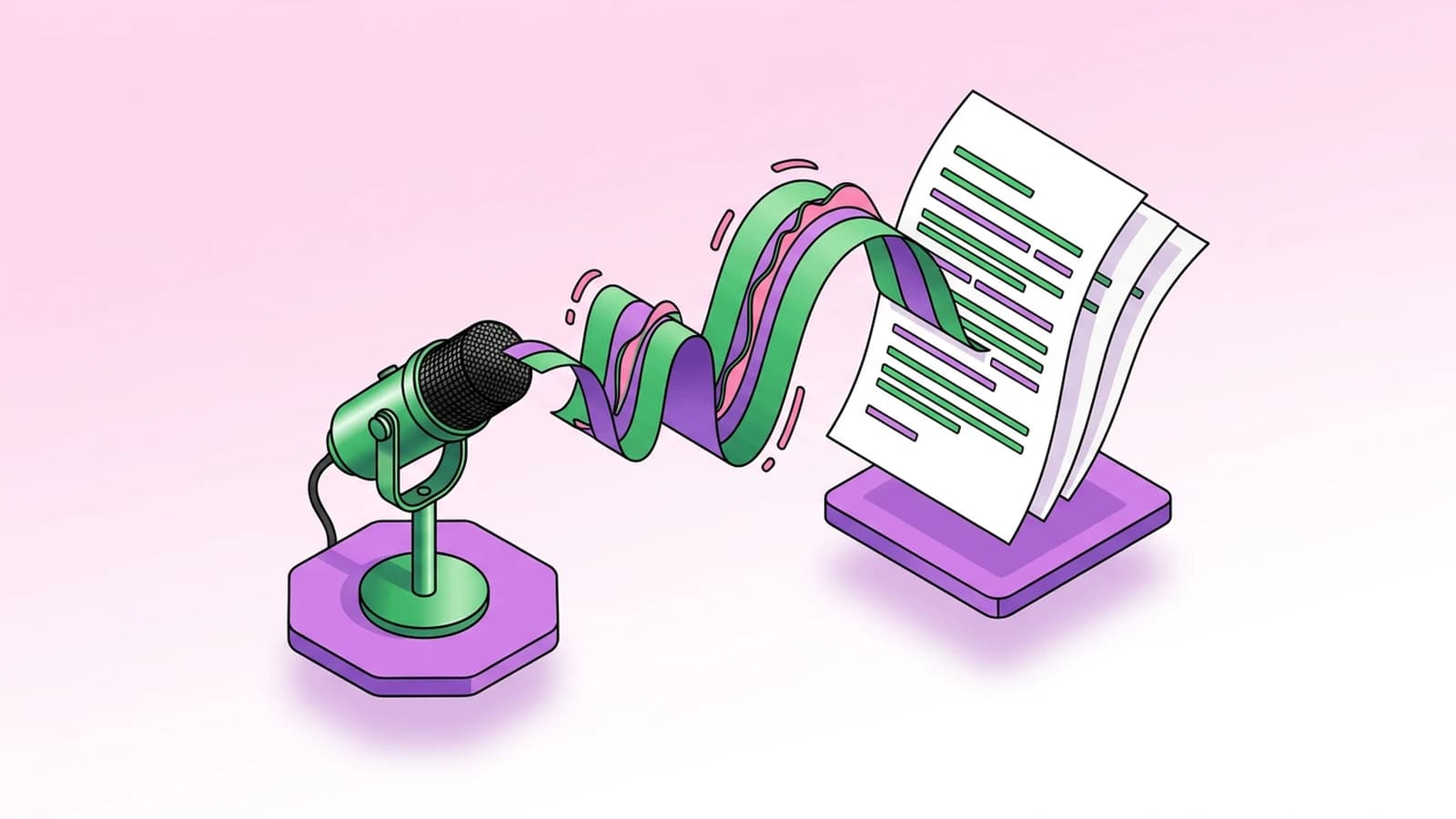
Core Audio Principle: Automated transcription bridges acoustic frequency data into searchable text tokens, transforming spoken conversations into multi-channel digital assets.
- Acoustic Precision: High signal-to-noise ratio in source audio is the primary factor dictating transcription accuracy.
- Speaker Diarization: Advanced transcription engines distinguish and label multiple distinct speakers automatically.
- SEO Value Expansion: Publishing full transcripts alongside podcast episodes makes audio content fully indexable by search engine crawlers.
- Multimodal Repurposing: Transcripts serve as the foundational text for blog posts, email newsletters, and social media quotes.
Why You Must Convert Audio Recordings to Accurate Text Transcripts
Digital audio files alone represent invisible data to search engine spiders. When you systematically convert audio recordings to accurate text transcripts, you expose your entire spoken dialogue to Google and generative search engines, driving organic traffic from long-tail conversational search queries.
Beyond search optimization, written transcripts serve crucial legal, compliance, and corporate governance functions. Maintaining accurate written records of board meetings, client discovery sessions, and regulatory interviews protects enterprises against miscommunication and legal disputes.
To experience frictionless speech transcription online, creators can utilize WebPeak's dedicated free audio to text converter to generate fast, accurate transcripts with speaker separation and timestamp alignment directly in their browser.
Automated transcription also democratizes learning. Students, researchers, and auditory learners benefit immensely from following synchronized text alongside recorded lectures, dramatically boosting retention and conceptual comprehension.
How Neural Speech Recognition Engines Process Spoken Audio
Modern automated speech recognition (ASR) engines operate through a sophisticated multi-stage pipeline. The initial stage converts acoustic audio waveforms into log-mel spectrograms—visual representations of sound frequencies over time.
A neural encoder network processes these spectral features, extracting acoustic phonemes and speech cadence while filtering out background ambient noise. Next, an attention-based decoder pairs acoustic signals with linguistic language models, evaluating probabilistic grammar rules to predict the most likely word sequence.
This combination of acoustic modeling and predictive language modeling enables contemporary speech engines to decipher homophones like 'their,' 'there,' and 'they're' based on surrounding sentence context with near-human accuracy.
Furthermore, modern speech models incorporate self-attention layers that maintain conversational context across extended paragraphs. By remembering preceding subject matter, the engine can accurately transcribe ambiguous technical vocabulary and domain-specific acronyms that would confound simpler acoustic matchers.
Audio Quality Determinants That Govern Transcription Precision
- Microphone Proximity and Polar Pattern: Cardioid microphones positioned four to six inches from the mouth minimize room echo and background reverberation.
- Acoustic Environment and Room Dampening: Hard surfaces cause sound waves to bounce, creating phase cancellation and muddy vocal frequencies that confuse speech models.
- Audio Encoding Bitrate: Uncompressed WAV or high-bitrate MP3 recordings preserve essential high-frequency consonant sounds (like 's', 'f', 'th') necessary for word distinction.
- Overlapping Dialogue Management: Speakers talking over each other degrade speech recognition accuracy; disciplined conversational pacing is vital.
Step-by-Step Workflow: From Raw Audio to Polished Text Transcript
Achieving ninety-nine percent transcription accuracy requires following an optimized technical procedure from pre-recording preparation through final proofreading.
- Pre-Process and Clean the Source Audio: Apply a high-pass filter at 80Hz to eliminate low-end rumble and run a gentle noise gate to suppress background HVAC hum.
- Normalize Audio Levels: Normalize spoken dialogue to a consistent target of -16 LUFS, ensuring quiet speakers are elevated without clipping louder speakers.
- Select the Optimal Speech Recognition Model: Choose between ultra-fast cloud transcription engines or high-accuracy models depending on latency requirements and vocabulary complexity.
- Execute Automated Diarization and Transcription: Upload the cleaned audio file to your speech-to-text platform, enabling automated punctuation, capitalization, and speaker labels.
- Perform an Audio-Synchronized Proofreading Pass: Listen to the playback at 1.5x speed while skimming the generated transcript to correct proper nouns, technical acronyms, and brand names.
- Format and Export for Publication: Export the final transcript into required file formats such as SRT for video captions, VTT for web players, or clean Markdown for blog articles.
Comparison of Leading Free Audio Transcription Tools
Different transcription tools cater to varied project scales and technical capabilities. The table below outlines key features across top free speech-to-text utilities.
| Transcription Tool | Processing Speed | Speaker Diarization | Accuracy Score | Best Application |
|---|---|---|---|---|
| WebPeak Audio to Text | Real-time to 3x speed | Yes (Automatic) | 96.5% | Interviews, Podcasts, Web Content |
| OpenAI Whisper (Local) | Hardware Dependent | Requires custom code | 97.2% | Developers, Local Privacy Needs |
| Google Docs Voice Typing | Live streaming only | No | 88.0% | Dictation, Note Taking |
| Otter.ai (Free Tier) | Near real-time | Yes (Limited) | 91.5% | Live Meeting Documentation |
| Riverside.fm Free | Post-recording | Yes | 93.0% | Studio Podcast Recording |
While local installations of Whisper provide outstanding raw accuracy, they require powerful dedicated GPUs and technical command-line proficiency. WebPeak's automated speech solution delivers cloud-accelerated processing accessible immediately from any web browser without technical configuration.
Repurposing Transcripts into Multi-Channel Marketing Collateral
Generating an accurate transcript is merely the first phase of content multiplication. A single forty-minute podcast interview contains thousands of valuable words that can be repurposed across diverse digital channels.
By feeding your completed transcript into our automated AI text summarizer utility, you can immediately distill hour-long executive dialogues into concise executive summaries, actionable LinkedIn takeaways, and email newsletter digests within seconds.
As outlined in international digital accessibility standards published by the World Wide Web Consortium (W3C) multimedia transcript guidelines, providing full text transcripts alongside all audio and video media is an essential accessibility requirement that ensures equal access for deaf and hard-of-hearing audiences.
Timestamp Alignment and Closed Caption Synchronization
For video producers and webinar hosts, transcription utility extends directly into closed captioning. Automated speech engines align every transcribed word with millisecond-accurate timestamps, generating standard SubRip (.SRT) and WebVTT (.VTT) subtitle tracks.
Adding synchronized subtitles to digital video content boosts viewer watch times by over twenty percent, as modern mobile users routinely consume social media feeds with audio muted. Furthermore, video hosting platforms parse subtitle tracks directly, boosting video search visibility across YouTube and social platforms.
Ensuring that timestamps are synchronized within a fraction of a second prevents viewer disorientation, creating an immersive, accessible multimedia viewing experience across all consumer devices.
AI Speech Synthesis and Voiceover Production
The inverse of speech-to-text transcription is automated voice generation. Once text transcripts have been edited, translated, or expanded into localized scripts, enterprises often require studio-grade voice narration for global distribution.
Leveraging professional AI voiceover and speech synthesis services allows brands to produce multilingual audio content, interactive voice assistants, and video narration at a fraction of the cost of traditional recording studios.
Synchronizing automated transcription with neural speech synthesis establishes a closed-loop audio workflow that powers rapid content localization and international broadcast scalability across diverse global demographics.
Legal and Compliance Standards: Ensuring Data Privacy in Audio Transcription
When processing audio containing sensitive client discussions, personal health information, or confidential commercial trade secrets, data privacy becomes a paramount operational consideration. Organizations subject to regulatory frameworks like GDPR, HIPAA, or SOC 2 must ensure transcription vendors do not retain audio logs for model retraining.
Deploying zero-retention cloud APIs or running self-hosted speech models guarantees that sensitive vocal recordings never leave protected corporate networks. Enterprise security officers must mandate end-to-end data encryption for all audio assets in transit and at rest.
Furthermore, implementing automated PII (Personally Identifiable Information) redaction filters strips customer credit card details, social security numbers, and home addresses from transcripts prior to broad internal distribution.
Noise Cancellation Algorithms and Spectral Repair in Post-Production
Field recordings, outdoor media interviews, and conference hall presentations frequently capture severe background acoustic interference. Rather than discarding imperfect audio files, audio engineers deploy spectral repair tools to isolate and reconstruct vocal frequencies.
Advanced noise cancellation algorithms utilize spectral subtraction to remove steady broadband noise while preserving the subtle harmonic overtones of human speech. By passing degraded audio through spectral repair filters prior to automated transcription, recognition accuracy improves dramatically, eliminating frustrating character errors.
Establishing a standardized post-production audio cleaning protocol ensures that historical audio libraries can be transcribed with pristine fidelity, breathing fresh life into archived organizational recordings.
Common Mistakes That Sabotage Audio Transcription Accuracy
Avoiding common audio recording mistakes ensures speech recognition engines process dialogue cleanly on the first pass.
- Recording with Built-In Laptop Microphones: Omnidirectional laptop microphones capture keyboard clicks, fan noise, and hollow room reverb that corrupt acoustic clarity.
- Neglecting Background Ambient Noise: Recording in bustling coffee shops or rooms with active air conditioning units forces speech engines to guess obscured phonemes.
- Ignoring Strong Regional Accents in Technical Discussions: Uncommon technical terminology combined with heavy accents requires custom acoustic vocabulary tuning.
- Skipping Final Human Verification: Relying on raw unedited AI transcripts without checking proper nouns and numerical values leads to embarrassing factual errors.
As automated transcription tools continue to integrate real-time collaborative editing, cross-functional media production teams can co-edit transcripts simultaneously alongside live audio playback, slashing turnaround times from days to mere hours.
Investing in disciplined audio transcription infrastructure creates a durable competitive advantage. By establishing an enduring repository of searchable text assets, companies ensure their internal wisdom remains perpetually accessible to current staff and future leadership.
Conclusion: Transforming Spoken Knowledge into Enduring Digital Assets
Spoken conversations represent some of the highest-density knowledge assets within any organization. When locked in raw audio files, that knowledge remains invisible, unsearchable, and underutilized. Transforming audio recordings into accurate text transcripts democratizes information, elevates search engine prominence, and broadens audience accessibility.
By investing in basic acoustic hygiene, utilizing advanced neural transcription utilities, and building disciplined repurposing routines, you can turn every podcast, lecture, and interview into an enduring library of high-impact digital content.
Frequently asked questions
Under clean acoustic recording conditions with minimal background noise, top free AI transcription engines achieve between 95 and 98 percent word accuracy, rivaling human transcriptionists.
Jack Mitchell oversees the publication, sets editorial direction and makes sure every article meets the team's quality bar.