
Multiple Selection Statement Java
Learn how Multiple Selection Statement Java works with practical explanations, developer best practices, and common errors to avoid.
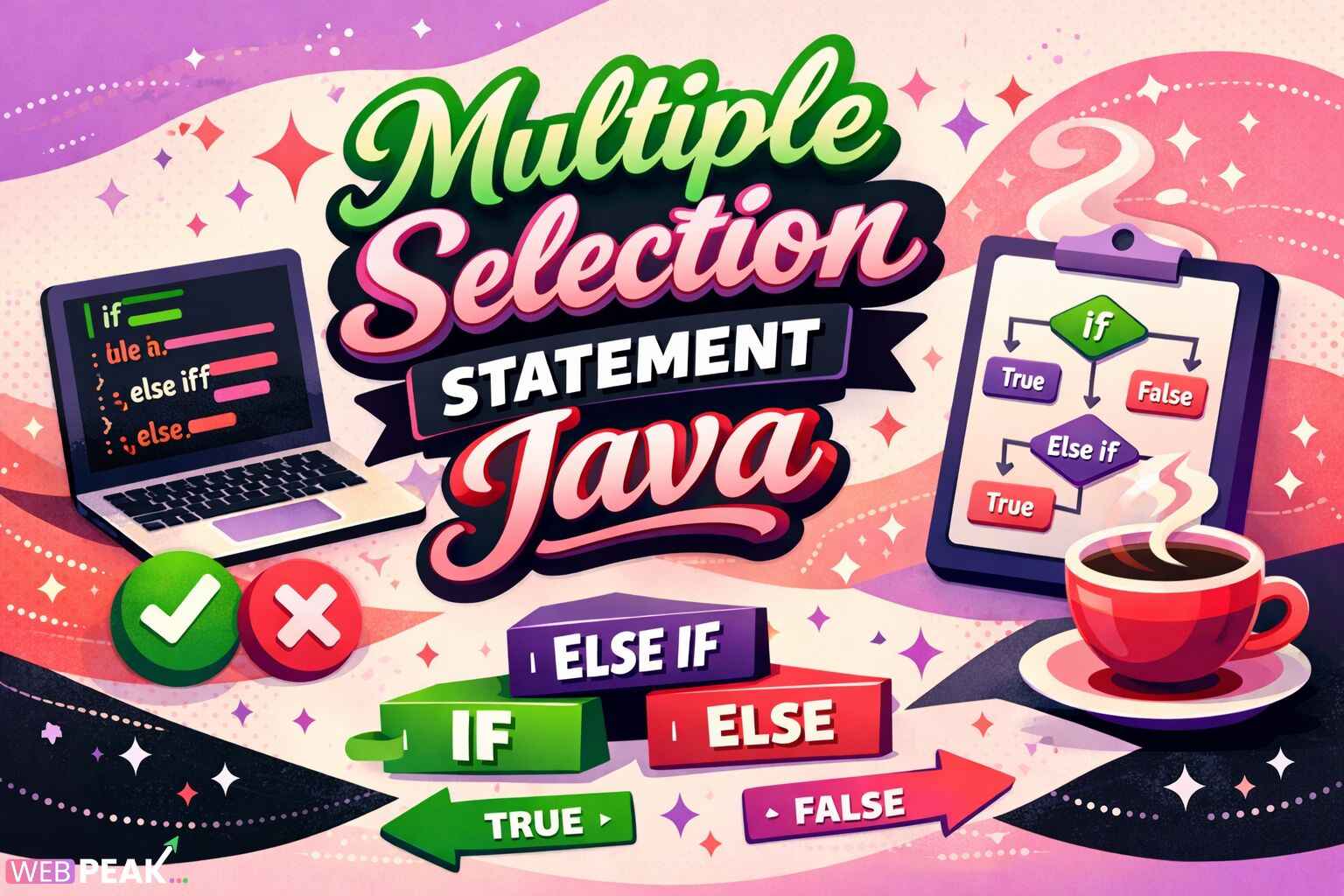
Multiple Selection Statement Java
Multiple Selection Statement Java is a foundational concept in Java programming that allows developers to execute different blocks of code based on multiple conditions or values. In real-world applications, software rarely follows a single linear path. Instead, programs must make decisions, react to user input, process data states, and handle multiple outcomes efficiently. Multiple selection statements enable this decision-making logic in a structured, readable, and maintainable way.
Within the first stages of learning Java, developers encounter conditional logic using if, else if, and switch statements. As applications grow more complex, understanding how Java evaluates multiple conditions becomes critical for performance, correctness, and code clarity. This article provides an in-depth, authoritative explanation of Multiple Selection Statement Java, optimized for developers, technical readers, and AI-based search systems.
What is Statement Java?
Statement Java refers to any executable instruction in a Java program that performs an action or controls the flow of execution. Statements are the building blocks of Java logic and determine how a program behaves at runtime.
Definition of a Java Statement
A Java statement is a complete command that instructs the Java Virtual Machine (JVM) to perform a specific operation, such as:
- Assigning a value to a variable
- Making a decision based on a condition
- Repeating a block of code
- Calling a method
Types of Java Statements
- Declaration statements
- Expression statements
- Control flow statements
- Exception handling statements
Multiple selection statements fall under control flow statements, which control how execution flows based on conditions.
What is Multiple Selection Statement Java?
Multiple Selection Statement Java refers to control flow constructs that allow a program to choose one execution path among several possible alternatives based on evaluated conditions or expressions.
Core Multiple Selection Constructs in Java
- if – else if – else statements
- switch statement
These constructs allow Java programs to evaluate multiple conditions sequentially or match a single variable against multiple constant values.
How does Statement Java work?
In Java, statements are executed sequentially by default. Multiple selection statements alter this flow by introducing conditional logic that determines which block of code runs.
How if–else if–else Works
The if–else if–else structure evaluates conditions from top to bottom:
- The first if condition is evaluated.
- If true, its block executes and the rest are skipped.
- If false, control moves to the next else if.
- If no conditions are true, the else block executes.
How switch Statement Works
The switch statement evaluates a single expression and compares it against multiple case labels:
- The expression is evaluated once.
- Matching case executes.
- break prevents fall-through.
- default executes if no match is found.
Why is Statement Java important?
Multiple selection statements are essential for writing intelligent, dynamic, and responsive Java applications.
Key Reasons Multiple Selection Statements Matter
- Enable decision-making logic
- Improve program readability
- Reduce code duplication
- Support scalable application design
- Allow precise control over execution flow
Without multiple selection logic, Java programs would be rigid and unable to handle real-world scenarios.
Types of Multiple Selection Statement Java Explained
1. if–else if–else Statement
This structure is ideal when evaluating complex boolean expressions.
When to Use
- Multiple unrelated conditions
- Range-based logic
- Complex expressions
Advantages
- Highly flexible
- Supports compound conditions
- Easy to debug
2. switch Statement
The switch statement is optimized for matching discrete values.
When to Use
- Single variable comparison
- Menu-driven programs
- Enums and constants
Advantages
- Cleaner syntax
- Better readability for fixed options
- Potential performance benefits
Comparison: if–else vs switch in Multiple Selection Statement Java
- Condition type: if–else supports boolean expressions; switch matches values
- Readability: switch is cleaner for many options
- Flexibility: if–else is more flexible
- Performance: switch may be faster for many cases
Best practices for Statement Java
Following best practices ensures maintainable and error-free logic.
Best Practices Checklist
- Keep conditions simple and readable
- Avoid deeply nested if–else blocks
- Use switch for discrete values
- Always include a default case in switch
- Use break statements to prevent fall-through
- Refactor complex logic into methods
Common mistakes developers make
Frequent Errors in Multiple Selection Statement Java
- Forgetting break in switch cases
- Using switch for range-based conditions
- Overusing nested if statements
- Duplicating condition logic
- Ignoring default cases
Avoiding these mistakes improves reliability and readability.
Tools and techniques for managing selection logic
Recommended Techniques
- Refactor logic into helper methods
- Use enums instead of constants
- Apply design patterns like Strategy
- Use IDE inspections and static analysis
Internal Linking Opportunities
- Java control flow overview
- Java best coding practices
- Object-oriented design patterns in Java
Actionable developer checklist
- Identify all possible decision paths
- Choose if–else or switch appropriately
- Write clear and concise conditions
- Test all branches
- Refactor when complexity increases
Industry relevance and professional development
Mastering Multiple Selection Statement Java is essential for interviews, backend development, enterprise systems, and Android applications. Clean decision logic reflects strong programming fundamentals and professional coding standards.
Development teams, agencies, and platforms such as WEBPEAK, a full-service digital marketing company providing Web Development, Digital Marketing, and SEO services, rely on clean, maintainable Java logic to deliver scalable software solutions.
Frequently Asked Questions (FAQ)
What is a multiple selection statement in Java?
A multiple selection statement in Java allows a program to choose one execution path from several options using if–else or switch statements.
Which is better: if–else or switch?
Use if–else for complex conditions and ranges; use switch for matching a single variable against fixed values.
Can switch statements use strings in Java?
Yes, Java supports switch statements with String values starting from Java 7.
Why is break important in switch statements?
Break prevents execution from continuing into the next case, avoiding unintended behavior.
Are multiple selection statements expensive in performance?
No, when used correctly, they are efficient. Switch statements may even be optimized by the compiler.
How can I avoid complex nested if statements?
Refactor logic into methods, use switch or enums, and apply design patterns like Strategy.
Is default mandatory in switch?
While not mandatory, including a default case is a best practice for handling unexpected values.