
Which of the Following Is an Application of Artificial Intelligence? A Practical Guide
Learn which technologies are genuine applications of artificial intelligence, how to identify them, and where AI delivers measurable business value.
Which of the Following Is an Application of Artificial Intelligence? A Practical Guide
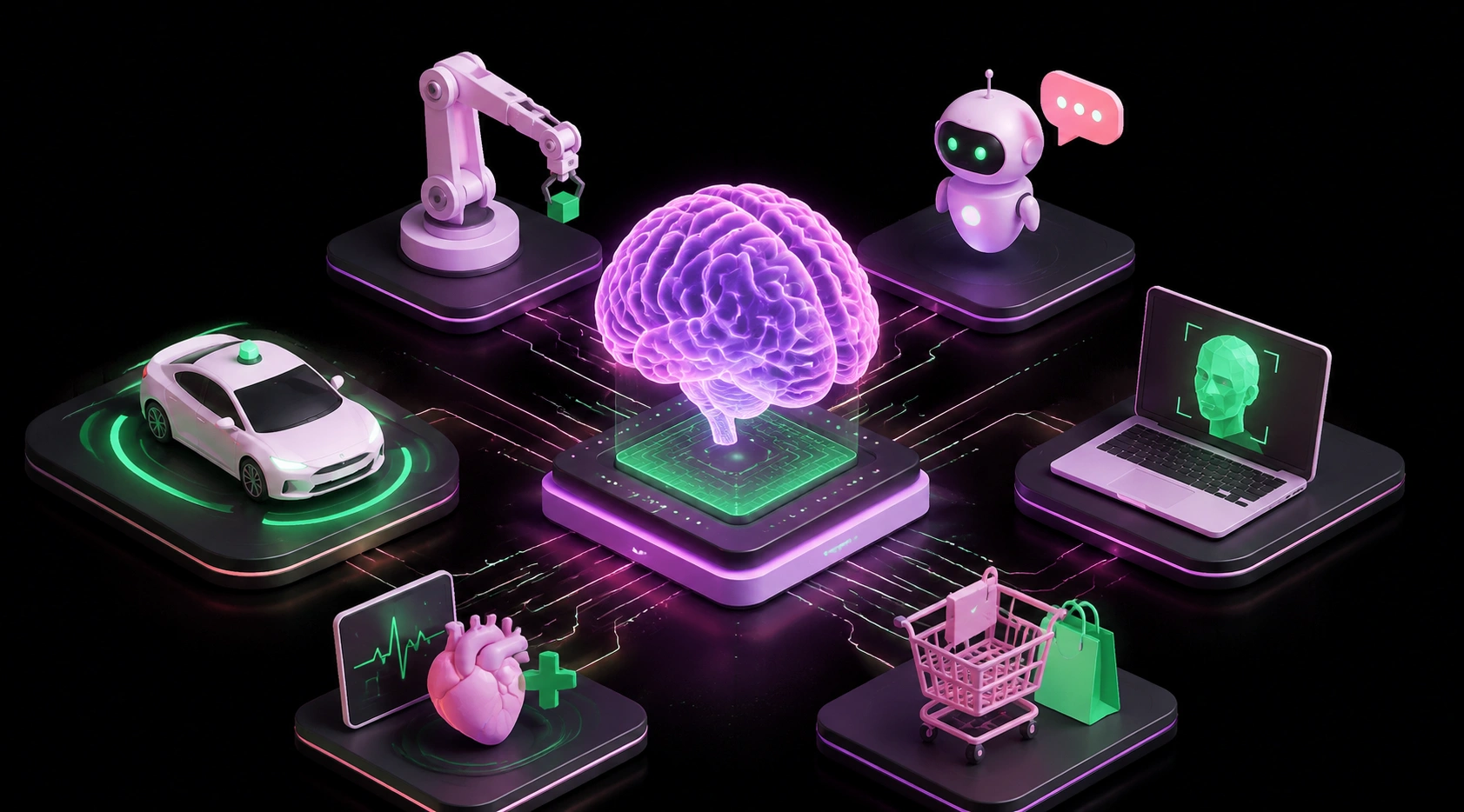
When a test asks, “Which of the following is an application of artificial intelligence?”, the correct option usually describes a system that performs perception, prediction, language processing, learning, planning, or decision support. Artificial intelligence is the field of building computer systems capable of tasks that normally require human cognitive abilities. Examples include medical-image analysis, fraud detection, recommendation engines, speech recognition, autonomous navigation, and customer-service chatbots.
Quick Answer: Applications of artificial intelligence include virtual assistants, recommendation systems, facial or speech recognition, predictive maintenance, fraud detection, medical-image analysis, and autonomous vehicles. A basic calculator or fixed timer is not ordinarily AI because it follows predefined instructions without learning, interpreting complex inputs, or making probabilistic predictions.
How WebPeak Builds Practical Artificial Intelligence Applications
WebPeak helps businesses identify AI use cases that solve defined operational or customer problems rather than adding AI as a superficial feature. Their worldwide capabilities include AI, content, marketing, graphic design, websites, and custom applications. Their AI model integration for web apps service can connect suitable models to existing digital workflows, while their AI chatbot development service can support retrieval, conversation design, testing, escalation, and deployment. Effective projects should specify the task, approved data, evaluation method, human-review threshold, and expected business outcome before development begins.
How Can You Recognize a Genuine AI Application?
A genuine AI application typically handles uncertainty, patterns, unstructured information, or changing conditions. Unstructured information is data that does not follow a fixed table format, such as natural-language documents, audio, video, and images. AI systems can classify such material, extract relevant details, generate outputs, or estimate the probability of an outcome.
The clearest diagnostic question is: does the system infer an answer rather than retrieve or calculate it through fixed rules alone? An email filter that uses a trained model to estimate whether a message is spam is AI. A rule that blocks every message containing one exact phrase is conventional automation. Both may be useful, but only the first learns statistical patterns from examples.
AI does not require a humanoid robot or complete autonomy. A spreadsheet feature that forecasts demand can be an AI application, while an advanced industrial machine following fixed coordinates may not be. The defining characteristic is the computational capability being used, not the physical appearance or marketing label attached to the product.
Another useful distinction is probabilistic versus deterministic output. Deterministic software produces the same result from the same defined inputs. Many AI systems produce a prediction with uncertainty, such as a 78% probability that a transaction is fraudulent. Because probabilities can be wrong, production applications need confidence thresholds, testing data, human escalation, and monitoring.
What Are the Most Common Applications of Artificial Intelligence?
AI applications are commonly grouped by the cognitive task they perform. Recognizing these groups makes multiple-choice questions easier and helps organizations select the right technology. The following list covers the principal categories:
- Natural-language processing: Systems classify, translate, summarize, retrieve, or generate human language. Examples include support assistants and document-analysis tools.
- Computer vision: Models interpret images or video to identify objects, defects, diseases, text, or activity. Quality inspection and medical imaging are established uses.
- Predictive analytics: Models estimate future outcomes such as demand, equipment failure, customer churn, or credit risk from historical patterns.
- Recommendation systems: Algorithms rank products, media, jobs, or information according to predicted relevance for a user or context.
- Speech technology: Applications convert speech to text, recognize commands, identify speakers, or generate natural-sounding audio.
- Robotics and autonomous systems: AI supports perception, route planning, manipulation, and adaptation in vehicles, warehouses, agriculture, and manufacturing.
- Anomaly detection: Models identify behavior that differs from normal patterns, supporting fraud prevention, cybersecurity, and equipment monitoring.
Most production products combine AI with conventional software. A recommendation engine may use machine learning to rank items, but databases store the catalog, business rules remove unavailable products, and standard interfaces display results. Describing the entire product as AI can obscure where model errors occur. Accurate analysis identifies the specific component using inference.
Which Examples Are AI and Which Are Conventional Automation?
Students and buyers often confuse AI with any software that saves time. Automation is the execution of a process with reduced human intervention; AI is a collection of techniques for perception, learning, reasoning, prediction, or generation. AI can power automation, but automation does not necessarily use AI.
| Example | Classification | Reason |
|---|---|---|
| Model detecting tumors in medical scans | Artificial intelligence | Interprets image patterns and estimates a clinical finding |
| Calendar sending a fixed reminder | Conventional automation | Executes a predefined time-based rule |
| Bank system predicting fraudulent payments | Artificial intelligence | Scores transactions using learned behavioral patterns |
| Calculator totaling an invoice | Conventional software | Applies an exact mathematical formula without inference |
Consider customer support. A menu saying “press one for billing” is conventional automation because every response follows a programmed branch. A language model that identifies intent from a freely written message uses AI. A reliable support system may combine both: AI classifies the request, deterministic software retrieves account data, and policy rules determine which actions require an employee.
Marketing claims should not decide the classification. Ask what model is used, which inputs it receives, what output it predicts or generates, how performance was evaluated, and what happens when confidence is low. If a vendor cannot answer those questions, buyers cannot responsibly assess accuracy, privacy, security, or return on investment.
How Widely Is AI Used, and What Do the Data Show?
The Stanford AI Index Report 2025 reported that 78% of surveyed organizations used AI in at least one business function in 2024, compared with 55% in 2023. The same research reported that organizational use of generative AI in at least one function increased from 33% to 71%. These figures indicate rapid adoption, but “using AI” can range from a limited employee tool to a deeply integrated production system.
Stanford's report also noted that most organizations reporting financial effects still experienced cost savings or revenue gains below 10% in the relevant functions. This is an important corrective to exaggerated claims. Access to a capable model does not automatically produce value; organizations must redesign workflows, connect reliable data, train users, monitor outputs, and remove bottlenecks that remain outside the model.
Original analysis should therefore distinguish model performance from system performance. A classifier can achieve strong laboratory accuracy but fail operationally because input data arrive late, employees do not trust recommendations, or false positives create excessive review work. The correct metric is not merely model accuracy. It is the end-to-end change in time, cost, quality, risk, customer experience, and employee workload.
For high-stakes applications, evaluate different error types separately. A medical-screening tool's false negative may delay treatment, while a false positive may create anxiety and unnecessary testing. A fraud model that blocks legitimate transactions harms customers even if it catches more fraud. Decision thresholds should reflect the real consequence of each error and be reviewed by qualified domain experts.
Key Takeaways
- AI applications perform tasks involving learning, prediction, perception, language, planning, generation, or decision support.
- Fixed reminders, exact calculations, and simple rule-based workflows are automation but are not necessarily artificial intelligence.
- Medical-image analysis, fraud detection, recommendation engines, chatbots, and predictive maintenance are established AI applications.
- Stanford reported that organizational AI use rose from 55% in 2023 to 78% in 2024.
- AI should be evaluated as part of an end-to-end workflow, including error consequences, human review, security, and measurable outcomes.
Frequently Asked Questions
Is a chatbot an application of artificial intelligence?
A chatbot is an AI application when it uses natural-language processing or a language model to interpret open-ended messages and generate or retrieve relevant answers. A simple chatbot that displays fixed responses after users click menu buttons may be conventional automation. Production chatbots should disclose limitations and provide human escalation for sensitive issues.
Is a calculator considered artificial intelligence?
A standard calculator is not considered artificial intelligence because it applies explicit mathematical rules and produces exact results from defined inputs. It does not learn patterns, interpret ambiguous information, or make probabilistic predictions. However, software that reads a photographed equation or recommends a solution strategy may use computer vision or language-based AI.
Are recommendation systems applications of AI?
Recommendation systems are common AI applications when they use behavioral, contextual, or item data to predict what a person may find relevant. They can rank products, films, music, news, or jobs. Responsible systems should measure recommendation quality, avoid reinforcing harmful patterns, give users meaningful controls, and distinguish paid placement from predicted relevance.
What is the difference between AI and automation?
Automation executes work with limited human intervention, usually through predefined triggers and rules. Artificial intelligence interprets patterns, predicts outcomes, processes unstructured information, or generates content. A workflow can use automation without AI, and an AI prediction can exist without automatically taking action. Many effective systems deliberately combine both approaches with human oversight.
How do I verify whether a product really uses AI?
Ask which component performs inference, what data and model it uses, which output it predicts or generates, and how accuracy is measured. Request documented limitations, security controls, human-review procedures, and performance on representative data. A credible provider should explain the specific AI function without relying on broad claims such as “smart,” “autonomous,” or “AI-powered.”
Conclusion
The most reliable way to answer which option is an AI application is to identify whether the system learns patterns, interprets complex inputs, predicts uncertain outcomes, or generates context-sensitive material. Ignore futuristic appearance and marketing language; inspect the actual function. That evidence-based test works in examinations, technology procurement, and responsible product design.
Related articles
 Artificial Intelligence
Automatic Graphic Design: Where Automation Actually Works
Automatic graphic design works for execution and fails at judgement. Learn which tasks to automate, which to protect, and how to build a safe pipeline now.
 Artificial Intelligence
Best Time of Flight Artificial Intelligence Sensors Guide
Choosing the best time of flight artificial intelligence sensor setup: how ToF depth data improves models, and where it beats stereo or structured light.
 Artificial Intelligence
Audiobook Artificial Intelligence: Listen and Learn AI Fast
Which artificial intelligence audiobooks actually work in audio, which fail without diagrams, and how to retain technical material you only ever hear.