How to Build Retargeting Funnels for People Who Visited Your Pricing Page
Discover how to build high-converting retargeting funnels for visitors who abandon your pricing page. Master behavioral segmentation and objection handling.

Key takeaways
Executive Summary- Pricing page abandoners possess high commercial intent and require tailored objection handling rather than generic brand ads.
- Partition retargeting audiences into 1-3 day, 4-7 day, and 8-14 day cohorts to match shifting buyer psychological states.
- Suppression lists of confirmed customers and active users must be updated in real time to prevent ad spend waste.
- Synchronizing paid remarketing ads with behavioral email sequences dramatically compounds conversion velocity.
Table of Contents
- Executive Summary: The Mechanics of Pricing Page Remarketing
- Deconstructing the Psychology of the Pricing Page Visitor
- Audience Segmentation: Building Precision Behavioral Cohorts
- Multi-Touch Attribution and Enterprise Procurement Delays
- Step-by-Step Implementation: How to Build Retargeting Funnels for Maximum ROAS
- Cross-Channel Synergies: Combining Paid Retargeting with Email Workflows
- Financial Modeling and Budget Allocation
- Common Retargeting Mistakes and How to Avoid Them
- Strategic Summary and Next Steps
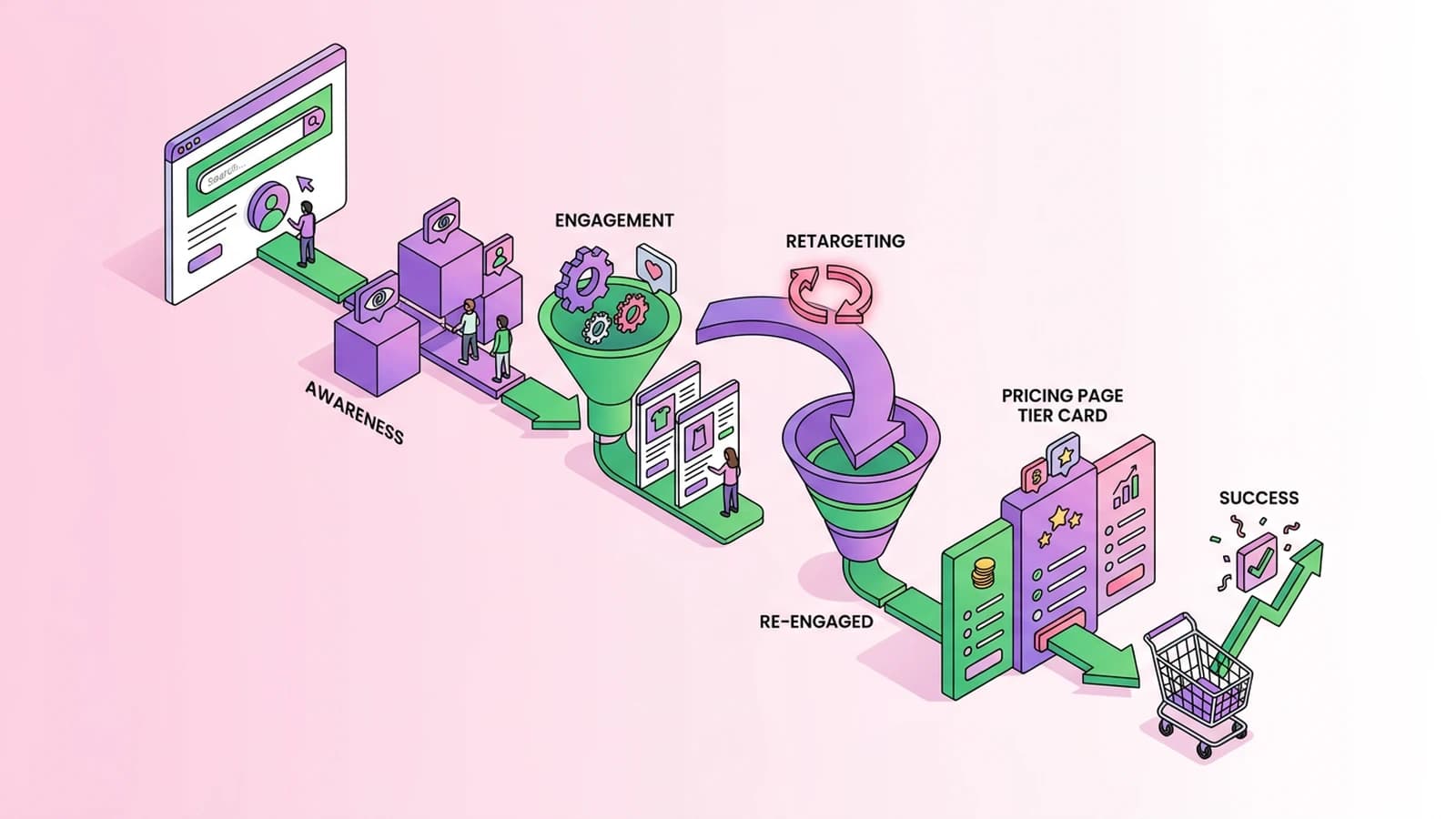
Mastering how to build retargeting funnels for visitors who reached your pricing tier matrix represents the highest-leverage conversion opportunity in modern performance marketing. When an engaged prospect navigates directly to your commercial tiers, examines monthly versus annual billing toggles, or reviews enterprise contract inclusions, they have progressed far beyond casual discovery. They understand their core operational pain point, recognize your category solution, and are actively balancing perceived financial risk against projected business return. In this comprehensive guide, you will learn how to architect high-intent retargeting funnels that dismantle lingering buyer skepticism, personalize follow-up touchpoints, and recover high-value deals before prospects retreat to competitors.
Most marketing teams treat pricing page visitors with clumsy, one-size-fits-all ad campaigns that serve generic brand awareness copy. In reality, abandoning a pricing page is rarely a sign of total disinterest; it is almost always driven by specific unaddressed frictions—such as contract lock-in anxiety, budget approval hurdles, feature ambiguity, or perceived implementation complexity. By segmenting visitors based on their on-page dwell depth, feature comparison engagement, and time elapsed since visit, your advertising infrastructure can deliver tailored messaging sequences that systematically resolve objections and accelerate sales pipeline velocity.
Executive Summary: The Mechanics of Pricing Page Remarketing
Before reviewing multi-stage audience segmentation and ad copy matrices, understand the core strategic foundations that govern high-converting remarketing pipelines:
- Pricing page abandoners represent high-intent commercial prospects actively evaluating economic risk against return on investment.
- Audience segmentation must be partitioned into acute time-decay windows (1 to 3 days, 4 to 7 days, and 8 to 21 days) with distinct psychological narrative angles.
- Dynamic frequency capping and strict buyer suppression lists protect brand equity and eliminate ad waste across retargeting audiences.
- Omnichannel orchestration across paid search, social video remarketing, and triggered automated email sequences compounds conversion lift.
Deconstructing the Psychology of the Pricing Page Visitor
To convert pricing page visitors into paying customers, one must accurately diagnose why they abandoned without transacting. A user reaching the pricing page has generally completed top-of-funnel discovery. They do not need another generic top-level explainer video defining the category. Instead, their hesitation falls into one of four distinct psychological friction categories:
First is economic uncertainty. The buyer is attempting to calculate their internal return on investment and wonder if cheaper alternatives exist. Second is implementation fear. In software and enterprise services, buyers fear that onboarding will disrupt existing team workflows or take months to produce value. Third is organizational inertia. The prospect agrees that the tool is valuable, but dreads the internal political capital required to get finance or executive procurement approval. Fourth is feature-to-price misalignment. The prospect may be unsure whether their team requires the Starter, Professional, or Enterprise tier.
Effective retargeting does not badger the user with identical discount codes; it serves educational and proof-driven creative units that directly alleviate these four exact frictions in a calibrated narrative sequence.
Audience Segmentation: Building Precision Behavioral Cohorts
High-converting retargeting funnels avoid lumping all pricing page visitors into a single monolithic 30-day audience pool. Instead, advanced practitioners segment traffic based on engagement depth and recency decay. Implementing granular behavioral segments ensures ad spend is weighted heavily toward prospects when purchase intent is acute:
| Recency Cohort | User State of Mind | Strategic Narrative Angle | Recommended Ad Formats | Daily Frequency Cap |
|---|---|---|---|---|
| Days 1 to 3 (Acute Intent) | Evaluating alternatives, remembering core features | Objection resolution & risk reversal (money-back guarantee, free migration) | Static social cards, video customer quotes, search remarketing (RLSA) | 4 to 6 impressions / day |
| Days 4 to 7 (Evaluation) | Internal debate, ROI calculations, competitor checks | Quantifiable case studies, third-party benchmark reports, social proof | Founding team video explainer, interactive comparison carousel | 2 to 3 impressions / day |
| Days 8 to 14 (Cooling Off) | Inertia set in, other daily priorities took over | Friction reduction: live interactive demo invite, free ROI assessment | Interactive lead forms, motion graphic feature walkthroughs | 1 to 2 impressions / day |
| Days 15 to 30 (Lapsed) | Likely delayed decision or chose alternate path | Major product update announcement, seasonal incentive, direct founder note | Editorial static card, LinkedIn message / sponsored update | 1 impression every 2 days |
Configuring these audiences requires combining first-party tag events with robust audience parameters as outlined in the Google Ads remarketing technical documentation. Setting custom URL rule groups (such as 'URL contains /pricing AND URL does not contain /thank-you') establishes the bedrock logic for programmatic remarketing.
Multi-Touch Attribution and Enterprise Procurement Delays
In high-consideration B2B transactions, pricing page abandonment often signals the start of internal stakeholder reviews rather than deal cancellation. Multiple team members—including technical architects, legal counsel, and finance controllers—routinely inspect the pricing matrix over several weeks before initiating contract discussions. A single analytics cookie cannot capture this distributed corporate buying committee without dedicated account-based retargeting.
By mapping IP-to-company data and matching pricing page visitors against LinkedIn company lists, growth teams can launch multi-threaded retargeting campaigns that address executive concerns simultaneously. While technical users see product feature deep-dives, finance leaders see compliance credentials (SOC 2, ISO 27001) and quantifiable total cost of ownership reductions. This multi-tiered exposure accelerates consensus across the entire buying committee.
Step-by-Step Implementation: How to Build Retargeting Funnels for Maximum ROAS
Follow this sequential operational roadmap to design, configure, and launch an enterprise-grade pricing page retargeting engine:
- Step 1: Deploy Micro-Event Tracking on the Pricing Matrix. Do not track simple page views alone. Implement Google Tag Manager event triggers that record micro-actions on the pricing page: annual versus monthly billing toggle clicks, tier plan card hover events, enterprise contact sales modal expansions, and FAQ accordion clicks. This granular telemetry allows you to isolate users who engaged deeply from those who bounced in under three seconds.
- Step 2: Construct Clean Exclusion and Conversion Suppression Lists. Nothing destroys ad efficiency faster than serving retargeting ads to users who already purchased. Create dynamic exclusion audiences that capture successful checkouts, payment confirmations, and active account logins. Set membership duration to 180 days and exclude this audience permanently from all top-of-funnel retargeting ad sets.
- Step 3: Build Recency-Decay Ad Sets Across Meta and Google Networks. In Meta Ads Manager and Google Ads, construct dedicated campaigns containing the 1-3 Day, 4-7 Day, and 8-14 Day custom audiences. Use negative audience exclusions between ad sets (e.g., Target 4-7 Days EXCLUDING 1-3 Days) to prevent audience overlap and ensure prospects experience an intentional sequential ad narrative.
- Step 4: Align Ad Creative Assets to the Funnel Narrative. Assign specific creative assets to each recency stage. For the 1-3 day cohort, highlight frictionless risk reversals such as 'Try risk-free for 14 days, cancel anytime with one click'. For the 4-7 day cohort, deploy customer video testimonials demonstrating quantifiable business growth. For e-commerce brands, integrate specialized e-commerce optimization solutions to trigger personalized dynamic catalog retargeting units.
- Step 5: Synchronize Omnichannel Touchpoints and Sales Sequences. For B2B organizations with identified leads, bridge paid retargeting with outbound sales outreach. If an identified CRM contact visits the pricing page, trigger an automated task for the account executive to initiate follow-up while paid ads simultaneously reinforce social proof across their personal LinkedIn and Instagram feeds.
Cross-Channel Synergies: Combining Paid Retargeting with Email Workflows
Paid retargeting reaches peak effectiveness when synchronized with automated email marketing workflows. If a prospect who visited your pricing page is already a subscriber in your marketing database, running paid ads in isolation wastes budget. Coordinating your paid ads with high-converting welcome email sequences for B2B and SaaS establishes a cohesive, multi-touch conversion environment.
For instance, when a known subscriber visits the pricing page and exits, your marketing automation platform can pause generic newsletter distributions and trigger a targeted three-part behavioral email sequence. Simultaneously, paid social ads present visual case studies from companies in the subscriber's specific industry vertical. This synchronized cross-channel pressure dramatically shortens sales cycles.
Financial Modeling and Budget Allocation
Because pricing page retargeting audiences are inherently smaller than cold prospecting pools, budget management requires strict discipline to prevent audience burn. In standard performance marketing setups, retargeting budgets should account for fifteen to twenty-five percent of overall paid media spend.
To model your target acquisition costs and ensure remarketing campaigns yield positive unit economics, calculate expected repayment periods and cash flow impact. Financial operators can utilize a free loan and financial installment calculator to stress-test financing models, customer payback horizons, and lifetime value projections across differing churn assumptions.
Common Retargeting Mistakes and How to Avoid Them
Even seasoned growth marketers frequently undermine their retargeting returns by falling into preventable technical and strategic traps. Safeguard your remarketing spend by avoiding these errors:
- Failing to Suppress Existing Customers: Serving introductory discount ads or 'Why Choose Us' videos to paying customers who regularly visit the site to log in wastes capital and frustrates loyal users. Always enforce strict server-side customer exclusion lists across all retargeting channels.
- Aggressive Frequency Without Creative Rotation: Bombarding a prospect with the identical static image ad eight times a day quickly induces ad fatigue, annoyance, and brand erosion. Implement frequency caps of three to five impressions per day and rotate at least three distinct creative formats.
- Ignoring Mobile Device Experience Differences: Many pricing page visitors browse on mobile during transit, but prefer executing financial transactions on desktop. Failing to bid on cross-device remarketing or failing to optimize mobile checkout forms causes immense drop-off.
- Relying Exclusively on Heavy Discounting: Defaulting to an immediate twenty percent discount ad trains your market to stall on pricing pages to wait for price cuts. Lead with value reinforcement, risk reversals, and onboarding support before offering price reductions.
Strategic Summary and Next Steps
Your pricing page is the monetary gateway of your digital business. Every visitor who reaches this touchpoint has signaled clear commercial curiosity. Leaving their conversion to chance is a severe operational oversight. By building multi-tiered retargeting funnels structured around recency decay, behavioral segmentation, and systematic objection resolution, you capture latent demand and maximize the ROI of every top-of-funnel dollar spent.
Begin by auditing your current pricing page analytics today. Set up micro-event tracking in Google Tag Manager, verify your suppression audiences, and launch a structured 1-3 day acute intent retargeting test. Transforming abandoned pricing visits into predictable revenue will drive sustained commercial acceleration for your enterprise.
Frequently asked questions
For transactional e-commerce and low-cost SaaS products, a 7 to 14 day retargeting window is optimal because purchase decisions happen quickly. For high-ticket B2B enterprise software with lengthy sales cycles, extending retargeting windows to 30 or 60 days with lower frequency caps maintains top-of-mind awareness during executive procurement deliberations.
Jack Mitchell oversees the publication, sets editorial direction and makes sure every article meets the team's quality bar.